
The Complaint Was Escalated. Who Has It Now?
Picture a busy service office. A homeowner calls because the explanation on an invoice does not match what they understood at the appointment. The CSR listens, adds a note, and sends the concern to a manager. The customer calls again the next afternoon. A different CSR answers and starts looking for someone who knows what happened. This is an illustrative situation, not a customer case study.
It is tempting to ask why the first CSR did not follow up. Before doing that, look at the process. Could that person approve an adjustment? Was the manager available? Did anyone accept the escalation? Was there a promised update time, or just a message sitting in an inbox?
Your team needs more than permission to escalate. They need somewhere reliable for the problem to go.
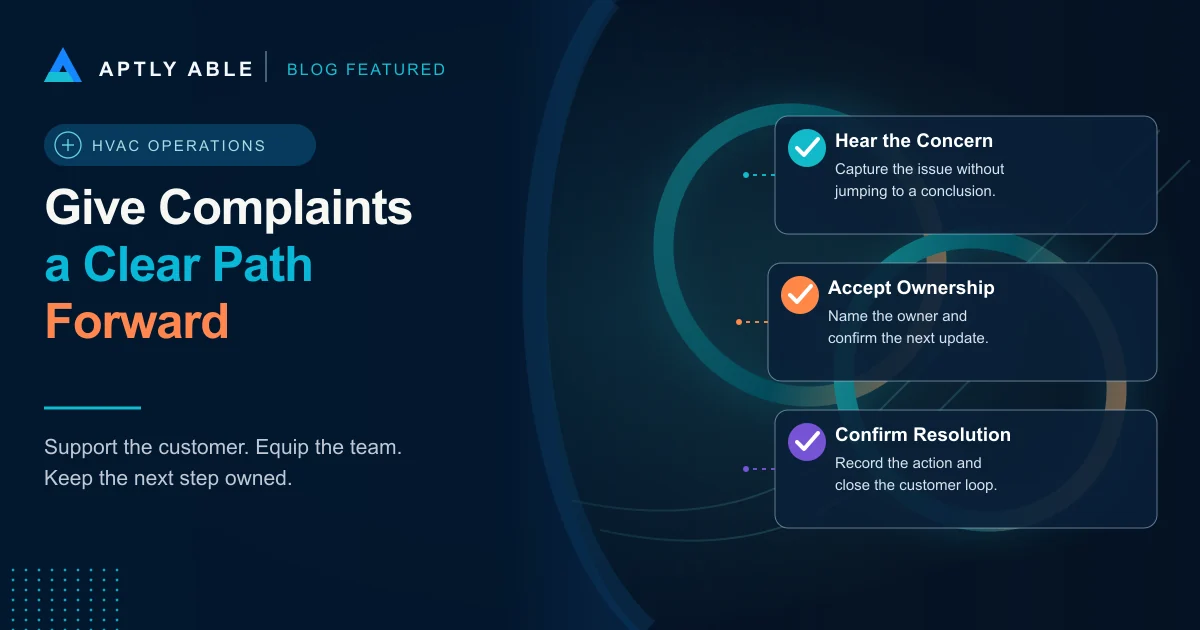
A useful HVAC customer complaint process captures the concern, checks urgency, assigns an available owner with the right authority, confirms the next update, and records what actually resolved the issue. Treat those as separate steps. Sending a message is not the same as someone taking responsibility for the next action.
Make It Possible to Listen Without Promising a Fix
Start by giving the frontline team a clear boundary. They can acknowledge the customer's experience, capture what happened, and explain the next step. They should not have to decide fault, promise a refund, or diagnose a system just to get a frustrated caller off the phone.
For example, a CSR could say: I understand the invoice is not what you expected. Let me record which part is unclear and get it to the person who can review the appointment and charges. This is sample wording, not a real customer conversation. Pair it with an update time only after checking what the responsible team can meet.
Ask what the customer wants clarified or corrected, then read back the concern in plain language. Keep the customer's report separate from the company's findings. Customer says the charge was not explained is a useful intake note. Technician failed to explain the charge is a conclusion that needs evidence.
That distinction protects both people. The customer should not have to prove the whole case during intake. The employee should not be judged before anyone has reviewed the work.
Create a Short Record the Next Person Can Use
Subtrak's published HVAC complaint workflow separates documenting the details, assigning a manager or team lead, clarifying expectations, and investigating the issue.[1] Use that separation as a starting point rather than trying to finish an investigation inside the intake form.
Keep one complaint record connected to the relevant customer and job. Capture the concern in neutral language, when it was reported, the outcome requested, relevant job references, any commitment already made, the next action, and the owner. Record the customer's preferred approved contact route. Limit access to the people who need the information.
Do not make a CSR copy the entire job history into a second system. Link to the existing record and highlight the disputed detail. If a customer contacts the office again, add the update to the same case instead of creating another disconnected version.
A complaint is not automatically a technical callback. A billing question, an unexplained delay, or a concern about communication may need review without a return visit. Keep this complaint-resolution lane separate from technical diagnosis and dispatch, while linking the records when field work is required.
Route by Urgency and Authority, Not by Who Is Nearby
Define the routing rules before the difficult call arrives. An ordinary billing explanation needs a different receiving role from a reported safety concern, property damage, or an allegation about employee conduct. Follow the company's established emergency and specialist escalation procedures for those situations; do not put them into a routine callback queue or ask an intake employee to improvise technical advice.
For routine complaints, name the role that can investigate and the role that can approve the available remedy. Those may be different people, but the customer still needs one communication owner. Give that owner a backup when a manager is away or tied up in the field.
Make acceptance visible. The receiving person should acknowledge the case and its next action in the shared record. Until that happens, keep it in an unaccepted-escalations view with a supervisor responsible for rerouting overdue items. Do not quietly hand the monitoring burden back to whichever CSR happened to answer first.
Choose response targets your staffed operation can support, with faster handling for higher urgency. These are internal operating commitments, not a universal industry deadline. Review capacity before promising a customer a time the team cannot meet.
Keep the Customer Updated While the Answer Is Still Open
An investigation may require the invoice, job notes, a conversation review, and input from the employee involved. Set a next-update time independently of the hoped-for resolution time. The owner should be able to provide a truthful progress update even when the answer is not ready.
A useful update explains what has been checked, what is still being reviewed, and when the customer will hear from the company again. Avoid sending internal speculation or making another employee the explanation for the delay. If the deadline will slip, contact the customer before it passes and record the revised commitment.
CallSense and FieldSense are relevant here as conversation-review resources, not as substitutes for investigation. Review available context alongside the operating record. Check a flagged statement or summary against the underlying evidence before using it to decide what happened. Do not assume a complaint is substantiated simply because a system marked a conversation as negative.
The practical question for the owner is not whether someone sent an update. It is whether the customer received a clear next step and whether any unanswered question still has a person responsible for it.
Close the Issue, Not Just the Task
Subtrak's workflow includes completing corrective work, following up with the customer, logging the outcome, and reviewing trends internally.[1] Those are useful distinctions when deciding what closed should mean in your own system.
Record the finding, approved action, completion evidence, and customer communication. If an adjustment was approved but has not been applied, the remedy is still pending. If an explanation was sent but the customer disputes it, record that disagreement rather than marking the customer satisfied.
Use statuses that describe reality: investigating, awaiting an internal decision, remedy in progress, awaiting customer response, resolved and communicated, or closed after the defined contact process with no response. Keep customer confirmation as its own field. No reply is not proof of satisfaction.
Do not make a remedy conditional on a favorable review or a new purchase. Handle the concern on its merits. If appropriate future work follows, measure it separately; an apology, credit, or completed correction is not automatically recovered revenue.
Review the Pattern Without Turning It Into Blame
At a regular operations review, examine where complaints waited: before acceptance, during investigation, while awaiting approval, or after a promised update. Keep the count of cases reviewed alongside any rate. Separate technical concerns from billing and communication issues so a change in case mix does not become an unfair comparison between employees.
Look at repeat contact about the same unresolved concern, missed update commitments, and cases reopened after closure. These are prompts for investigation, not automatic evidence of poor performance. A reopened case may reveal an incomplete remedy, new information, or a closure rule that was too broad.
Ask the team what made the next step difficult. If a CSR documented the concern accurately but nobody could approve the response, more listening training is not the correction. If the evidence shows a recurring unclear explanation, coach that specific behavior using reviewed examples and a standard the employee understands.
Start with one improvement the team can feel: a visible acceptance step, a dependable backup owner, or an update commitment that stays on the board until it is fulfilled. Then review comparable cases again. The goal is not to make people carry complaints more quietly. It is to give them a process that helps the customer and lets the team finish the work.
HVAC Customer Complaint Process FAQs
What should an HVAC customer complaint process include?
Include neutral intake, an urgency check, an accepted owner, investigation, an approved response, a next-update commitment, and documented closure. Link the complaint to the job and keep customer reports separate from verified findings.
Who should own an escalated HVAC complaint?
Assign an available person or staffed role that can coordinate investigation and customer communication, with access to the appropriate decision-maker. Name a backup and make acceptance visible rather than treating a forwarded message as ownership.
Is every HVAC complaint a callback?
No. A complaint may concern an invoice, timing, or communication without requiring another technical visit. Use a complaint-resolution record and link it to dispatch or technical work when that work is needed.
When should a customer complaint be marked resolved?
Mark it resolved when the agreed action is complete and the outcome has been communicated under your closure rules. Record customer confirmation separately, and do not treat silence or an unfulfilled approved remedy as confirmed satisfaction.
How can managers coach complaint handling fairly?
Review the original concern, available evidence, employee authority, receiving team's response, and update commitments before judging performance. Coach a demonstrated behavior gap; fix routing or capacity problems when the process caused the delay.
Recommended next reads
Related Aptly Able resources
- CallSense Bring customer conversations into the review of concerns, promises, and follow-through.
- FieldSense Connect field-conversation context with the office's understanding of the concern.
- Reducing HVAC Callbacks Explore the separate technical-return-visit and prevention workflow.
- Call Quality Calibration Agree on what the evidence supports before coaching an employee.
- Revenue Recovery Audit Find where customer conversations and unresolved follow-up are losing momentum.
Helpful external reading
- [1] Subtrak: Customer Complaint & Issue Resolution for HVAC A published HVAC workflow covering intake, assignment, investigation, corrective action, customer follow-up, and process review.