
Do Not Confuse a Faster Message With a Better Response
The goal of a lead-response system should not be to win a race between autoresponders. It should be to help a customer reach someone who can take responsibility for what happens next.
Speed matters. But speed without ownership is an incomplete standard.
For an HVAC business, define lead response time as the elapsed time between a new inquiry arriving and a clearly specified response event. Then name that event. An acknowledgment, a callback attempt, a two-way conversation, and a confirmed appointment are different things. They should not share one convenient label.
A message saying the request was received may be useful. It is not evidence that anyone has understood the need, checked availability, or accepted the follow-up. Build the system to distinguish those steps rather than rewarding the first message and ignoring the rest.
Treat Speed as a Leadership Decision, Not Just a Timer
Jobber's 2026 Home Service Trends Report discusses faster response among higher-earning businesses alongside structured systems and automation; its methodology includes a survey of U.S. home service business owners and aggregated platform data.[1] That is useful context, not proof that installing an autoresponder causes revenue growth.
The leadership question is more specific: what response can this business reliably deliver, and who has the authority to deliver it?
An employee cannot confirm a window they cannot see. An answering service cannot responsibly promise a dispatch that nobody has approved. AI should not be asked to hide either limitation behind confident language.
Make the policy real before making the timer impressive. Define the service area, the kinds of requests each team can handle, the available scheduling authority, and the path for exceptions. Then use automation to support those decisions, not invent them.
Keep Three Response Events Separate
Use separate timestamps for acknowledgment, first substantive attempt, and two-way contact. Keep the original inquiry timestamp as the starting point for each. These are proposed operating definitions, not universal industry standards.
Acknowledgment means the business confirms receipt and sets an honest expectation. First substantive attempt means someone, or an approved workflow, tries to move the actual request forward with relevant information or a clear question. Two-way contact means the customer participates in that exchange. Record appointment confirmation separately.
For each event, elapsed response time equals its timestamp minus the original inquiry timestamp. A callback that reaches voicemail can be an attempt. It is not two-way contact. An automated acknowledgment should not silently stop every clock.
Do not remove unanswered inquiries from the report because there is no completed response time to calculate. Show them as still open, with their current age. Otherwise, the oldest neglected request can disappear from the very metric meant to expose it.
Keep duplicate messages attached to the same opportunity when they concern the same need. A customer who calls after submitting a form should not reset the original waiting time or become two separate recovered opportunities. Preserve the interaction history so a manager can audit the classification.
A Shared Inbox Is Not an Accountable Owner
Consider an illustrative situation, not a customer case study: a homeowner sends a replacement inquiry in the evening. The system immediately acknowledges it. In the morning, the office assumes sales has it; sales assumes the office will qualify it. The technology responded. The business did not finish the handoff.
The missing requirement is acceptance. Assign a person or staffed role, require that owner to accept the request, and specify what happens if acceptance does not occur by the internal deadline. A role can provide coverage, but the record should make clear which person is currently responsible.
The owner does not need to do every task. The owner needs to know the current state, the next action, and when another person has accepted responsibility. Forwarding an email is not enough. Changing a CRM field is not enough. The handoff is complete when the receiving person has the context and accepts the next step.
Keep that context practical: what the customer requested, what has already been said, the agreed contact channel, any scheduling constraints, and the next promise the business must keep. Do not make the customer reconstruct the conversation because the business changed departments.
After Hours, Make an Honest Promise
Separate routine after-hours inquiries from requests that belong in the company's approved urgent-service process. Do not let a generic lead workflow diagnose equipment, give safety assurances, or imply emergency coverage the business does not offer.
For routine requests, state when a qualified person will respond and how the customer can use the available service channels. If the business cannot confirm an appointment until the office opens, say so. A transparent limitation is better than a fast promise the team cannot fulfill.
Measure both elapsed customer waiting time and, if useful, staffed-hours response time. Label them separately. Pausing an internal clock overnight does not mean the homeowner stopped waiting.
Choose targets based on actual coverage and request type, then review exceptions. There is no need to present a universal five-minute rule or a guaranteed conversion multiplier to justify removing an avoidable delay. Before adding automated texts or outreach sequences, have the responsible team approve channel permissions, opt-out handling, and applicable contact rules.
Use Evidence to Find the Delay You Can Actually Fix
ServiceTitan's dashboard documentation separates inbound call booking rate from its table of unbooked and abandoned calls; the latter includes timestamps and call details and supports recording playback.[2] Those are useful inputs for a response review, but they do not replace a complete history of form submissions, messages, assignments, and follow-up.
Start with the oldest open qualified inquiries. Ask where each one stopped: intake, assignment, acceptance, attempted contact, customer reply, or scheduling. Separate a missing owner from an unavailable customer. Separate a capacity limit from an employee failing to follow an approved process.
Review the typical waiting time and the slowest cases rather than relying on an average alone. Segment business-hours and after-hours requests, and keep channel and request type visible. A blended number should not conceal the queue that needs attention.
CallSense can be part of reviewing what was actually said and which opportunities need follow-through. Keep the promise narrower than the technology pitch: use conversation evidence to help people act, then verify the action in the operating record. Do not assume that a flagged call has already been contacted or booked.
Set a Standard the Customer Can Recognize
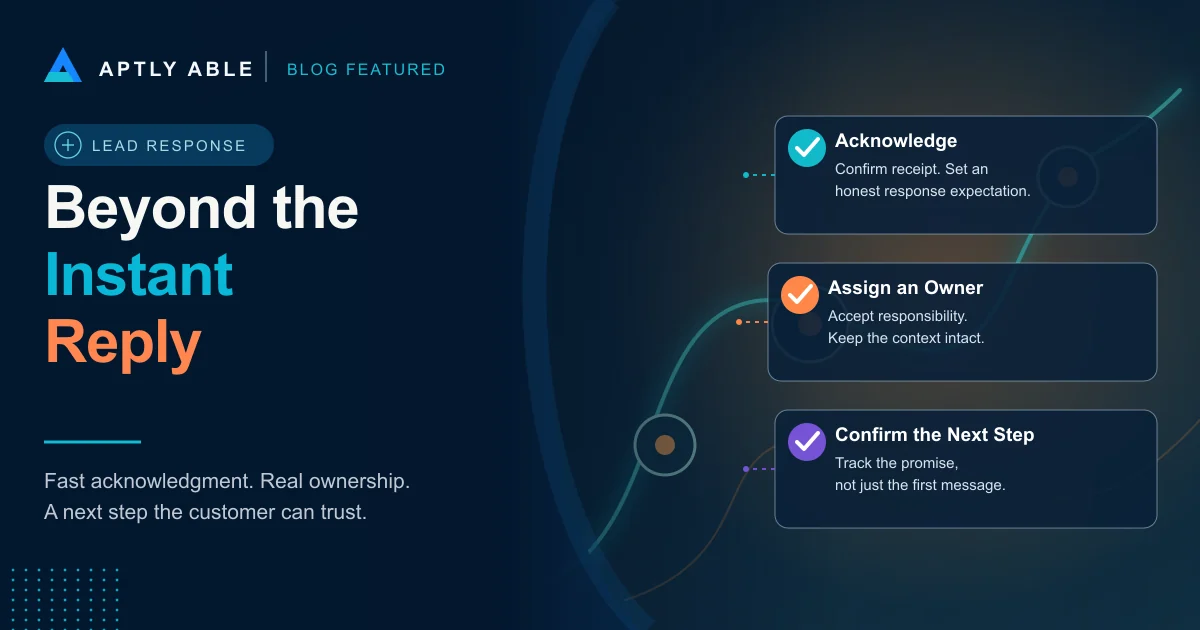
A better response system should make three things visible: the request was received, someone owns it, and the customer knows the next step.
Judge the process by that chain. Track contact, appointments, completed work, and documented outcomes separately. If faster acknowledgment does not improve the path to an appropriate next step, investigate the handoff before celebrating the dashboard.
Start with one unresolved inquiry and trace it from arrival to its current owner. Repair the missing responsibility, not just the notification. Then apply that standard to the queue.
Automation should remove waiting and administrative noise so people can do the work that requires judgment. It should not create the appearance of attention while responsibility remains undefined.
The standard is not simply a fast reply. It is a clear, honest response followed by someone who owns the promise.
HVAC Lead Response Time FAQs
How should an HVAC company measure lead response time?
Measure elapsed time from the original inquiry to a named response event. Track acknowledgment, first substantive attempt, and two-way contact separately, and show unanswered inquiries with their current age.
Does an automated reply count as responding to a lead?
It counts as an acknowledgment if it confirms receipt. Do not count it as two-way contact or an appointment. Keep those events separate so a fast automated message does not hide unfinished follow-up.
What is a good HVAC lead response time target?
Set an explicit target for each request type and coverage period that the team can reliably meet. Review the oldest requests and missed promises, and tighten avoidable delays rather than treating a universal benchmark as a guarantee.
Who should own an after-hours HVAC inquiry?
Assign it to the approved on-call or next-shift role, with a named person accepting responsibility when coverage begins. Routine and urgent-service requests should follow separate approved processes, with clear customer expectations.
Is lead response time the same as call booking rate?
No. Response time measures waiting until a defined response event. Booking rate measures the share of qualified opportunities that reach a confirmed appointment. Use both without treating an acknowledgment as a booking.
Recommended next reads
Related Aptly Able resources
- CallSense Bring customer conversations into the review of missed opportunities and promised follow-up.
- Missed Call Recovery Explore the recovery workflow for calls that did not connect.
- HVAC Call Booking Rate Measure whether qualified calls actually become scheduled work.
- HVAC Revenue Recovery Connect lead response with database, estimate, and field opportunities.
- Revenue Recovery Audit Examine where existing opportunities lose momentum before buying more demand.
Helpful external reading
- [1] Jobber: 2026 Home Service Trends Report Primary research discussing lead response, structured systems, and business performance; observational findings, not a promised conversion lift.
- [2] ServiceTitan: Dashboard Call Metrics Product documentation defining inbound booking rate and the evidence available for unbooked and abandoned calls.