When the Feedback Depends on Who Listened
Imagine a service representative finishing a busy morning of booking calls. One supervisor reviews a conversation and says the callback promise was handled correctly. Another hears the same conversation and marks it incomplete. The representative is now expected to improve, but the managers have not agreed on what improvement means.
This is an illustrative situation, not a customer case study. It is also a useful place to examine the review process before asking the employee to change. The team needs a clear standard, not another meeting where the most confident reviewer wins.
Call quality calibration means having reviewers evaluate the same interaction against the same criteria, then resolving differences in how those criteria are applied. NiCE describes that approach in its calibration documentation: select a call and form, have evaluators score independently, and review the results to coach consistent scoring.[1]
For an HVAC or other home service office, the practical question is simple: can we explain the same decision to the employee, regardless of which manager reviewed the call?
Bring One Real Disagreement, Not a Stack of Grades
Start with a disputed behavior that matters to the customer. Perhaps a callback had no clear time, an appointment expectation was ambiguous, or the representative handed off a question without confirming who would answer it. Keep the session focused on that issue rather than trying to redesign the entire scorecard.
The manager responsible for quality should bring the approved scorecard version, the relevant policy, and the recording or other permitted evidence. Give each reviewer access to the same material. If a recording is incomplete or the necessary context is missing, mark the item for review rather than treating missing evidence as proof of employee failure.
Have reviewers record their answers before discussing the call. Ask for the criterion, the decision, the supporting moment, and the rule used. This follows the independent-review sequence in NiCE's calibration workflow; the evidence notes are a practical addition for this process.[1]
A small office does not need a separate QA department to do this. An office manager and another authorized reviewer can start with one disputed call. Make the work small enough to finish, and keep customer recordings inside the company's approved access and retention controls.
Separate What Happened From What the Rule Requires
Consider an illustrative call where the representative promises a callback later today. One reviewer passes the next-step criterion because a time frame was given. Another fails it because no exact hour was stated. Neither reviewer should change the result simply to make the scores match.
Read the actual criterion. Does it require an agreed time frame, a specific appointment time, or a company-defined response window? Did the customer accept that arrangement? Was the responsible person documented where the policy requires it? The answer must come from the approved standard and available evidence, not a preference introduced after the call.
If the rule only says clear follow-up, the disagreement may belong to the scorecard. Replace that wording with an observable requirement, such as confirming who will respond and an agreed time frame that the team can actually meet. Define the applicable exceptions before using the revised item in employee evaluations.
NiCE's quality-management guidance recommends form components that provide actionable, objective metrics and coaching points.[2] Apply that principle here: a representative should be able to understand what action meets the standard without guessing which supervisor will listen.
Record a Decision the Next Reviewer Can Use
Keep a short calibration decision record. Include the call reference, criterion and form version, each original decision, the evidence location, the agreed interpretation, and who approved it. Add the effective date when the wording or policy changes. Avoid copying unnecessary customer details into a separate spreadsheet.
For the illustrative callback dispute, the record might explain that an agreed same-day window satisfies the current criterion when the owner is documented, unless a more specific commitment was required. That is an example of a decision format, not a universal callback policy. Your operation must set a promise it can deliver.
Do not settle an unresolved rule by averaging the scores. Send the policy question to the accountable manager, name a due date, and hold that disputed item out of consequential employee decisions until it is resolved. Keep the customer's follow-up moving through a separate owner while the reviewers work out the scoring.
If the earlier evaluation was wrong, correct it and explain the correction to the employee. If the rule is new, communicate the new expectation before judging later calls against it. People should not have to discover a changed standard through a lower score.
Calibrate AI-Assisted Reviews Against the Same Evidence
When AI assists with call review, use the same approved criteria and evidence standard. For this workflow, treat an automated score as a proposed evaluation that still needs validation, not as the deciding vote in a disagreement between people.
Compare the flagged moment with the recording where available and permitted. Check whether a transcript omission, speaker assignment, or missing context changes the interpretation. If the system cannot show enough evidence to support a finding, route it for human review rather than filling the gap with an assumption.
Separate a definition problem from an interpretation problem. If people cannot agree on what the criterion means, rewrite and test the criterion. If they agree on the rule but the automated review applies it incorrectly, document the mismatch and use the available configuration or support process to address it. Do not assume changing a prompt fixes every affected evaluation.
After a change, review fresh examples as well as the original disputed call. Include straightforward and difficult conversations so the check is not limited to the one case used to make the adjustment. Keep high-impact employment decisions under accountable human review. These are recommended operating safeguards, not claims that a particular product automatically performs them.
Coach the Behavior Without Hiding the Process Problem
Once the standard is clear, bring the employee into a specific coaching conversation. Replay or describe the relevant moment, explain the agreed requirement, and ask what made that step difficult. Then practice the action that should happen next time.
If the representative knew the callback needed an owner but had no way to assign one, the fix is not just better wording on the phone. The manager needs to repair the assignment process. If the tool and policy were clear but the step was missed, coach the step. Keep both kinds of accountability visible.
Recognize correct work too. If the representative met the approved standard and the disagreement came from the reviewers, say so. Do not turn a successful appeal into a coaching session about an unrelated weakness just to preserve the original criticism.
CallSense is a relevant starting point for teams exploring call intelligence and coaching opportunities. Whatever tools the office uses, the manager still owns the interpretation, the feedback, and the next action. A more organized review process should make that responsibility easier to carry, not easier to avoid.
Check Whether the Same Disagreement Comes Back
After the session, assign an owner to update the criterion and communicate the decision. Choose the next review date based on the team's capacity and how consequential the issue is. Revisit the affected item when policies, call types, or evaluation tools change; do not wait for another employee dispute to reveal the same confusion.
Track disagreements by criterion alongside the number of shared items reviewed. Keep evidence problems, unclear rules, and incorrect application separate. A smaller dispute count means little if reviewers evaluated fewer shared calls, and agreement alone does not prove the rule is fair or useful.
Then check the customer work behind the score. Was the callback actually assigned? Did the next person receive the context? Was an unresolved opportunity given an appropriate follow-up? Keep those outcomes separate from the calibration result so a tidy score does not substitute for completed work.
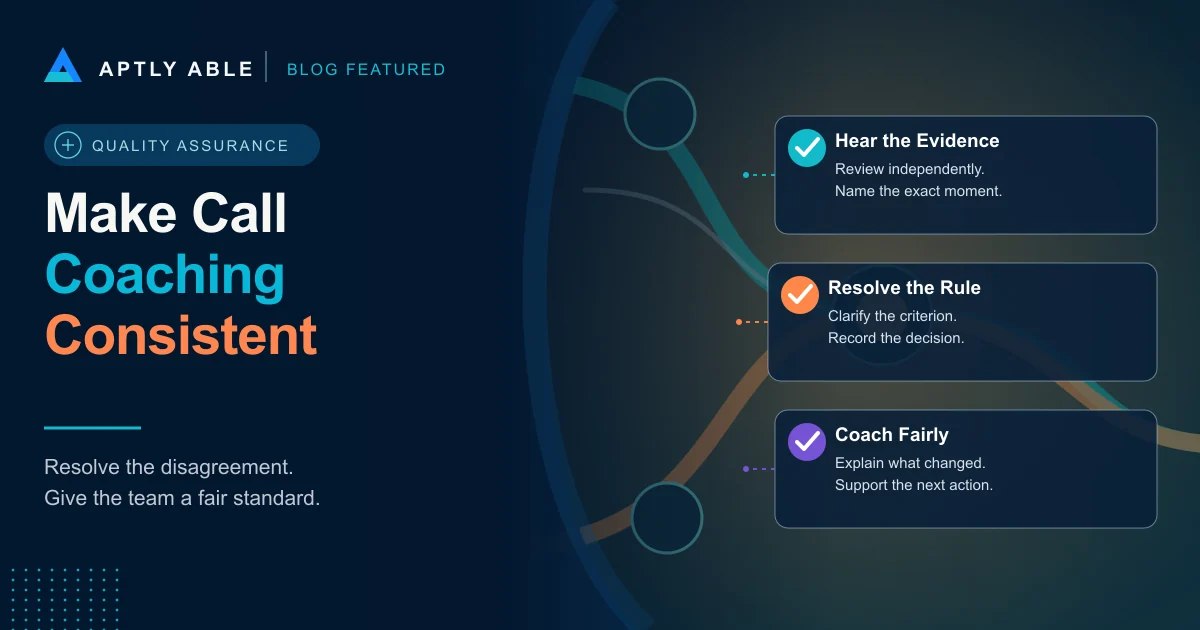
Start with one recurring disagreement and resolve it all the way through: evidence, rule, communication, coaching, and follow-through. The employee gets a standard they can trust. The manager gets something specific to teach. And the customer is less likely to be left waiting while the office debates what the score should have been.
Call Quality Calibration FAQs
What is call quality calibration?
Call quality calibration is a review process in which evaluators assess the same interaction against the same criteria, compare their decisions, and resolve differences in interpretation before using those standards for coaching.
What should a call calibration session produce?
It should produce an evidence-based interpretation of the disputed criterion, any needed wording change, an accountable owner, and a clear explanation for the team. Matching total scores without resolving the rule is not enough.
Who should own calibration in a small home service office?
The manager accountable for call quality should own the process, with another authorized reviewer assessing the same evidence independently. Policy disputes should go to the person authorized to resolve that policy.
How should a disputed AI call score be handled?
Check the relevant conversation against the approved criterion, look for missing or misinterpreted evidence, and document the decision. Keep consequential employee decisions under accountable human review rather than treating the automated score as final.
Is calibration the same as employee coaching?
No. Calibration aligns how reviewers apply the standard. Coaching helps an employee apply that standard in customer conversations. Resolve the review disagreement first so the employee does not receive conflicting instructions.
Recommended next reads
Related Aptly Able resources
- What Is Call Scoring? Start here to build the underlying scorecard; this calibration guide focuses on resolving disagreements about it.
- CallSense Explore call intelligence for finding coaching needs and missed customer opportunities.
- Why Reviewing 1% of Customer Calls Is No Longer Enough Connect consistent review standards with broader visibility into customer conversations.
- HVAC Call Booking Rate Keep booking outcomes distinct from the quality of the conversation.
- Revenue Recovery Audit Identify where unclear ownership and missed follow-through leave existing opportunities unresolved.
Helpful external reading
- [1] NiCE: Calibration Overview Primary product documentation describing independent evaluations of the same call and form, followed by reviewer coaching.
- [2] NiCE: Plan Your Quality Management Strategies Quality-program guidance emphasizing actionable, objective metrics and coaching points.