
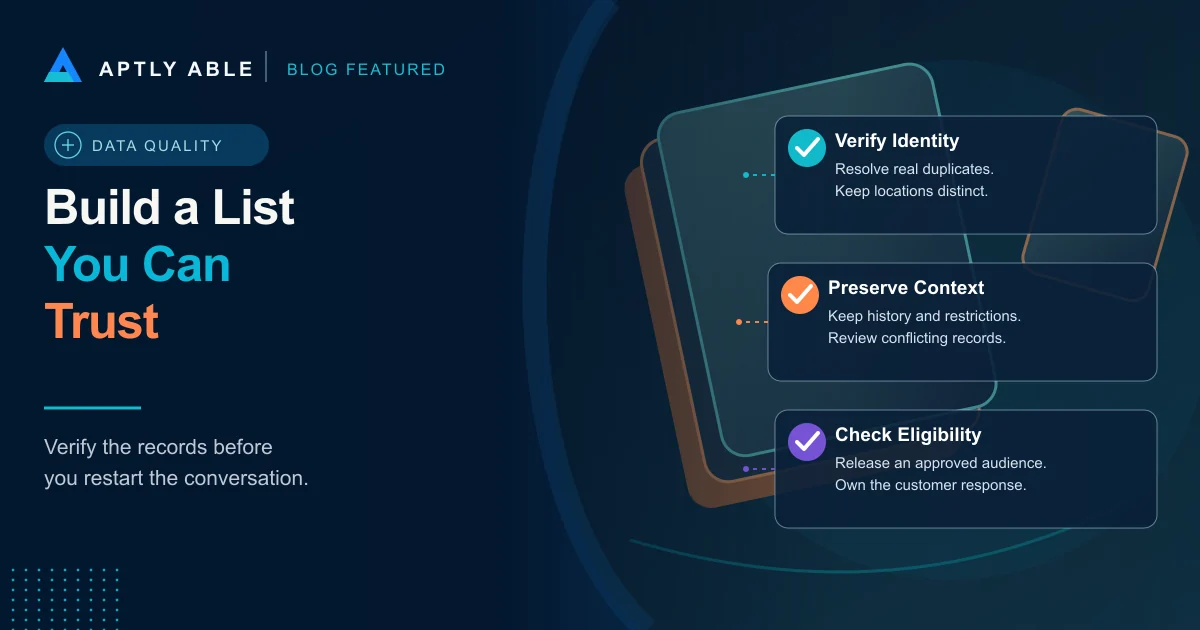
A Bigger Export Is Not a Better Opportunity
Before asking how many customers you can reach, ask whether you can trust what the list says about them.
An HVAC customer database should be more than a collection of names and phone numbers. For a reactivation decision, it needs to connect the right person with the right service history, a relevant reason to reconnect, and a contact route your business has cleared for that purpose.
HVAC customer database cleanup is the work of making those relationships reliable: identifying duplicate records, correcting verified errors, preserving context, and separating campaign-ready contacts from records that need review. It is not permission to erase inconvenient history or contact everyone who appears in an export.
That distinction comes before segmentation, messaging, or automation. A polished campaign cannot correct a mistaken identity. Faster outreach cannot make an unsupported assumption true.
Define What a Customer Record Represents
Start with the model, not the delete button. Keep the person, the billing account, the service location, and the equipment distinct wherever your system supports those relationships. Write down which identifier the campaign will use and what it identifies.
Consider an illustrative case: one property manager is responsible for several service addresses. A shared phone number does not make those properties duplicate jobs. Conversely, two slightly different names may refer to the same customer. A matching field is a reason to investigate, not automatic permission to combine everything attached to it.
Preserve the original customer and location identifiers in the working export. When someone responds, the receiving team should be able to reach the correct operating record without guessing which spreadsheet row was used.
Treat identity as a business decision supported by evidence. Let software find possible matches. Keep a person responsible for resolving ambiguous ones.
Understand the Matching Rule Before You Import
Do not assume that every CRM interprets a repeated name, email address, or phone number the same way. HubSpot documents automatic contact deduplication by email address and supports Record ID or a unique-value property for import matching.[1] It also warns that an import without an email address or another unique identifier creates a new contact for each row.[1] Those are HubSpot rules, not instructions to apply blindly to your field-service platform.
Read the current import and merge documentation for the system you actually use. Check which fields identify existing records, which values an import overwrites, and what happens to linked history. Confirm whether a merge can be reversed before using it as a cleanup shortcut.
Keep an access-controlled original export and a change log. Test a small, deliberately varied set before changing the full database: a clear duplicate, a shared household contact, a multi-property account, and a record with contact restrictions. Review the resulting records and associations, not just an import-success message.
The standard is not that the file uploaded. The standard is that the right records changed and nothing important disappeared.
Preserve the Context That Makes Outreach Appropriate
For each proposed merge or correction, decide what must survive: service history, open work, unsold estimates, customer preferences, contact restrictions, and the evidence behind those restrictions. Record which source resolved a conflict and who approved the change.
Do not let the newest row automatically win. A recent export may contain less context than the operating record. A blank field is not evidence that an earlier restriction no longer applies. If two records disagree about whether outreach is appropriate, hold the contact out of the campaign until the responsible person resolves the conflict.
Keep marketing eligibility separate from service history. Someone may need to remain in the business's records for ongoing work while being excluded from a reactivation campaign. Removing the person from a campaign audience is not the same action as deleting the customer record.
Use your approved channel-specific contact and suppression process before launch. Data cleanup does not establish consent, and a past transaction should not be treated as a blanket authorization for every outreach method. Have the appropriate compliance reviewer resolve uncertain eligibility; do not ask the campaign operator to invent a rule.
Separate a Valid-Looking Field From a Verified Fact
Standardize formatting without inventing information. Keep original values available when normalizing phone numbers, email addresses, or postal fields. Flag missing context instead of silently supplying a country code, service address, or customer relationship you cannot verify.
A neatly formatted phone number does not establish who answers it. A complete email field does not establish permission to use it. An old equipment entry does not establish that the same system is still installed.
Give uncertain records a review status and an owner. If there is no reliable way to resolve a field needed for the campaign, exclude that record from this launch. It can remain available for legitimate future review without being counted as campaign-ready today.
A smaller verified audience is a more honest starting point than a larger audience padded with assumptions. The objective is not to make the spreadsheet look complete. It is to make the next customer interaction accurate.
Make Campaign Readiness an Explicit Decision
Create a separate campaign snapshot rather than treating the entire cleaned CRM as the audience. Require a resolved identity, a relevant service context, a usable contact route, cleared eligibility for that route, and a named person or staffed team to handle responses.
Recheck current conditions before release. Exclude records where a new booking, unresolved complaint, changed customer preference, or other documented circumstance makes the planned message inappropriate. Keep the reason visible so the audience can be explained later.
This is where cleanup ends and segmentation begins. Cleanup asks whether the record can be trusted. Segmentation asks which relevant conversation belongs with that verified record. Keep those decisions separate rather than rewriting the existing segmentation strategy inside a data-cleaning project.
VoiceDrop belongs downstream of that readiness decision. Database outreach should start from an approved audience with a response path, not from the assumption that every exported row represents a warm opportunity.
Measure Trustworthiness Before Campaign Volume
Report the starting record count, confirmed duplicates resolved, unresolved matches, missing required fields, contacts excluded under the approved rules, and final eligible audience. Explain whether each count represents people, accounts, locations, or contact routes. Do not add overlapping exclusion categories as if they were distinct customers.
Keep this data-quality report separate from campaign results. A corrected record is not recovered revenue. A delivered message is not a booking. Connect later responses, appointments, and completed work to their actual operating records before making commercial claims.
Then inspect how the errors entered the system. Review forms, manual entry, imports, and integrations against the same identity rules. A one-time cleanup has limited value if the next upload recreates the same ambiguity.
Leadership should be able to ask three questions and get clear answers: Why is this person on the list? What do we know about the relationship? Who owns the response?
Build the system so those answers are available before the campaign starts. Recover opportunity from customer relationships you understand, not from rows you hope are right.
HVAC Customer Database Cleanup FAQs
What should HVAC customer database cleanup include?
Include identity checks, reviewed duplicate resolution, verified field corrections, preservation of service history and contact restrictions, and a separate campaign-readiness decision. Keep original identifiers and a change log.
Should customer records with the same phone number be merged?
Not automatically. A shared number may connect a household or multiple service locations. Review the person, account, location, and associated history before deciding whether the records represent the same entity.
Does cleaning a customer list make it ready for marketing?
No. Validate the campaign purpose, channel-specific eligibility, suppression rules, current customer context, and response ownership separately. A technically usable contact field does not establish permission to use it.
How is database cleanup different from customer segmentation?
Cleanup establishes whether records and relationships are trustworthy. Segmentation groups verified, eligible contacts by a relevant need or conversation. Complete the readiness checks before choosing a campaign audience.
How should an HVAC company measure database cleanup?
Track reviewed duplicates, unresolved matches, missing required information, exclusions, and the final eligible audience using clearly defined counting units. Report subsequent bookings and revenue separately from data corrections.
Recommended next reads
Related Aptly Able resources
- VoiceDrop Explore database outreach and warm opportunity creation after the audience is ready.
- Customer List Segmentation Decide which verified customers belong in which conversation.
- Measuring HVAC Revenue Recovery Keep campaign activity separate from documented business outcomes.
- Revenue Recovery Audit Review gaps in existing opportunities, records, and follow-through.
Helpful external reading
- [1] HubSpot: Deduplicate Records Primary documentation on email-based contact matching and unique identifiers for imports; specific to HubSpot, not a universal CRM rule.