
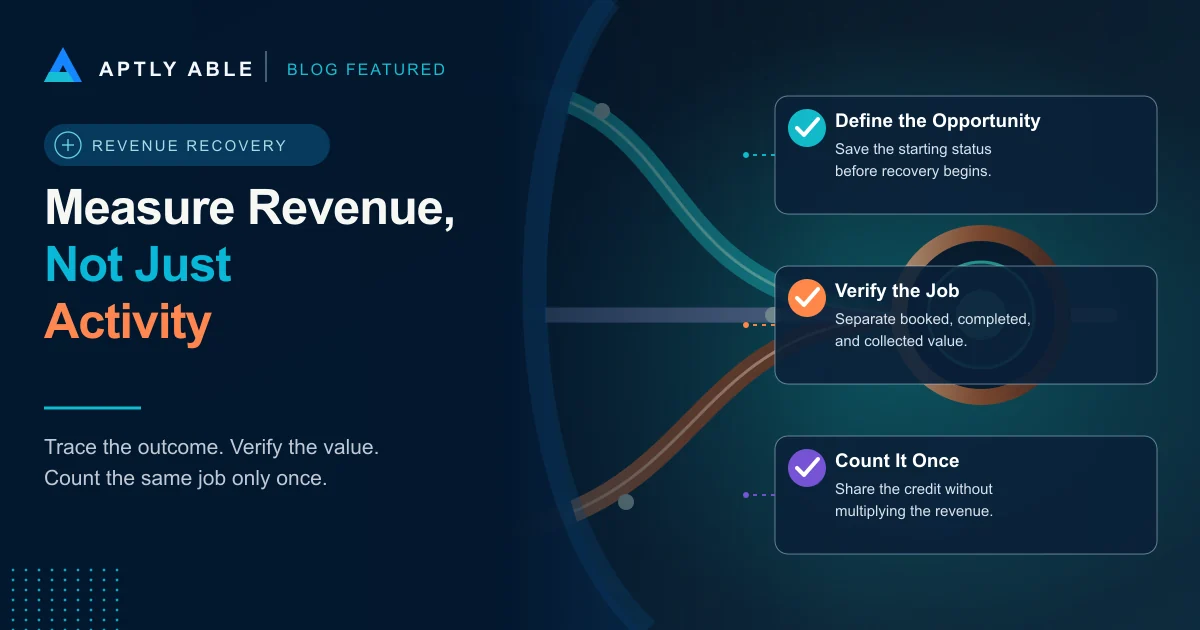
The Report Should Prove the Result, Not Sell It
A revenue recovery report should be harder to impress than the person presenting it.
If a campaign generated replies, report replies. If the team booked appointments, report appointments. If the work was completed and invoiced, report that value. Those are different achievements. Calling all of them recovered revenue makes the number bigger and the decision worse.
To measure HVAC revenue recovery, define the stalled opportunities before outreach, connect each recovery action to a unique job, and report the job's verified outcome on a stated financial basis. Keep attributed revenue separate from evidence that the recovery effort actually caused additional business.
The point is not to make the team defend every useful conversation. It is to give leadership a number that means the same thing in the campaign report, the job record, and the financial review.
Decide What Counts as a Recovery Before You Start
Begin with an eligibility rule. An unsold estimate with no booked installation is different from a job that was already scheduled before the campaign began. A previously unbooked caller is different from a customer calling to confirm tomorrow's visit.
For an estimate campaign, a practical rule might include estimates that were still open at the campaign start, had no accepted proposal or scheduled work, and were appropriate for another contact under the company's permissions and suppression rules. That is a proposed operating definition, not a universal industry standard.
Save the starting status and timestamp. Preserve the reason each record qualified. Exclude already-won work from the recovery total even if the customer later responds to the campaign.
Do not rewrite the starting line after seeing the result.
Build One Chain From Opportunity to Outcome
Use one opportunity identifier to connect the original inquiry or estimate, the recovery contact, the appointment, the resulting job, and its invoice or payment record. Keep the original marketing source and the later recovery source in separate fields. They answer different questions.
The original source answers where the relationship began. The recovery source answers what brought a stalled opportunity back into motion. Neither field needs to erase the other.
Record the recovery action, its date, the responsible person, the customer's response, and the agreed next step. Link the job rather than copying its value into several disconnected spreadsheets. If the match is uncertain, put it in an unmatched queue instead of silently awarding credit.
Google's offline conversion documentation describes connecting a later offline conversion to an earlier advertising interaction using identifiers and conversion details.[1] That is a useful example of the linking principle. It is not a reason to treat an advertising platform as your invoice ledger or to upload customer information without the appropriate privacy review.
Keep Booked, Completed, and Collected Value Separate
A booked installation can still be canceled. An accepted estimate can change scope. An invoice can remain unpaid. Make those differences visible instead of choosing whichever value produces the best headline.
For an operational recovery scorecard, use separate columns for appointments booked, accepted proposal value, completed-job invoiced value, and cash collected. Label taxes, refunds, discounts, deposits, and partial payments consistently with your finance team's rules. This scorecard is not a substitute for the company's accounting revenue-recognition policy.
Use a defined cohort: opportunities admitted to the recovery effort during a stated period. Show their outcomes as of a stated date. Do not compare a mature campaign with one whose appointments have not had time to run and call the difference a performance problem.
Keep canceled work out of completed-job totals. Update refunds and credits against the original job. Leave pending value visible as pending. A truthful report can contain unfinished business.
Count the Job Once, Even When Several People Helped
Consider an illustrative example, not an Aptly Able customer result: a homeowner originally came through a paid ad, left an estimate open, responded to database outreach, spoke with the office, and then accepted revised work after a field visit.
The ad helped create the opportunity. Outreach helped reopen it. The office and field team helped move it forward. That does not create four separate jobs' worth of revenue.
At company level, count the unique job once. In channel views, show the original source, the designated recovery source, and any assisted touches. If you allocate credit across channels, document the allocation and reconcile the shares to the single job total. Do not add multiple full-credit channel reports together.
For this illustrative record, the scorecard would show one eligible stalled estimate, the outreach and follow-up dates, the linked job identifier, and the verified completed or collected value when available. It would not add the estimate, invoice, and payment together as three recoveries.
Recognition can be shared. Revenue cannot be multiplied by the number of people who deserve it.
Attribution Is Not Proof of Incremental Revenue
A customer buying after follow-up does not, by itself, prove the customer would never have bought without it. Use attributed recovery to describe linked outcomes under your written rules. Reserve incremental recovery for an estimate of the additional outcome caused by the intervention.
Google's Conversion Lift documentation makes this distinction through controlled experiments comparing people who see an ad with a control group who do not.[2] Its specific product is not available to all Google Ads accounts.[2] The relevant principle here is the comparison, not a claim that every HVAC business can enable that tool.
For a nonurgent reactivation campaign, consider a properly designed randomized holdout if the list and outcome volume can support a meaningful comparison. Keep normal service and promised callbacks intact; never withhold an urgent response or an existing customer commitment to create a test. Ask a qualified analyst to set the comparison period, sample requirements, and uncertainty reporting before launch.
If a credible comparison is not practical, say so. Report observed attributed outcomes without claiming causal lift. You can make a useful operating decision without pretending to have answered a question your data cannot answer.
Judge the Economics on the Same Basis
Revenue is not profit. A high-value recovery can still consume substantial labor, equipment, concessions, and campaign effort. Ask finance to define the contribution basis before presenting a return-on-investment figure.
For a proposed campaign evaluation, compare the estimated incremental contribution before campaign expense with the full cost of the recovery effort. Include the relevant delivery fees and incremental internal work. Avoid subtracting the same expense twice. If you have only attributed job value, label a revenue-to-campaign-cost ratio as exactly that, not proven incremental ROI.
Do not manufacture lost revenue by multiplying every unanswered call or open estimate by an average ticket. Use unworked opportunities to prioritize investigation. Use actual linked outcomes to report what happened.
The standard should work in both directions: do not inflate a win, and do not charge an employee with a loss that the evidence does not establish.
Give Leaders a Scorecard They Can Challenge
A useful review should let a manager trace any reported recovery back to the opportunity, action, job, and financial status. Put the eligibility rule, cohort dates, outcome cutoff, attribution rule, exclusions, and unmatched records beside the totals.
Then use the stages to choose the next decision. Replies without bookings call for a review of fit, availability, and the next-step conversation. Bookings without completed work call for a look at cancellations, scheduling, and follow-through. Completed work without acceptable contribution calls for an economic review, not simply more outreach.
Apply the same evidence standard across database outreach, phone recovery, and field follow-up. VoiceDrop, CallSense, and FieldSense address different parts of that operating picture; the scorecard should connect the work rather than award each layer a separate copy of the same outcome.
Automation can help organize the evidence. People still own the definitions, the exceptions, and the decisions.
The best recovery number is not the largest number on the page. It is the one leadership can trace, explain, and act on without changing what the words mean.
HVAC Revenue Recovery Measurement FAQs
How do you measure HVAC revenue recovery?
Define eligible stalled opportunities before outreach, link each recovery action to a unique job, and report verified outcomes as of a stated date. Keep appointments, accepted value, completed-job value, and collected cash separate.
Does a booked appointment count as recovered revenue?
Report it as a recovered booking, not completed or collected revenue. Track the appointment through the job outcome and use an explicitly labeled financial basis for any dollar amount.
How do you avoid double-counting recovered jobs?
Count each unique job once in the company total. Record original source, recovery source, and assisted touches separately, and reconcile any allocated channel credit to that single job value.
What is the difference between attributed and incremental recovery?
Attributed recovery is an outcome linked to the effort under a stated crediting rule. Incremental recovery estimates the additional outcome caused by the effort. A linked sale alone does not establish what would have happened without follow-up.
Which date should a recovery report use?
State both the cohort period, when opportunities entered the effort, and the outcome cutoff, when their status was measured. Preserve contact, booking, completion, and payment dates so later results can update the same cohort.
Recommended next reads
Related Aptly Able resources
- HVAC Revenue Recovery Explore the commercial system for recovering opportunities your HVAC business already has.
- VoiceDrop Connect customer-database outreach to a defined follow-up and outcome process.
- CallSense Use call visibility to understand opportunities that did not reach a useful next step.
- FieldSense Bring field conversations into the review of appointment execution and follow-through.
- What Is Bid Recovery? Learn the follow-up process for unsold estimates before measuring its results.
- Revenue Recovery Audit Identify where existing opportunities stall and what evidence would establish a recovery.
Helpful external reading
- [1] Google Ads: About Offline Conversion Imports Primary documentation on connecting later offline outcomes to earlier advertising interactions.
- [2] Google Ads: About Conversion Lift Primary documentation distinguishing incremental outcomes through treatment and control groups.