
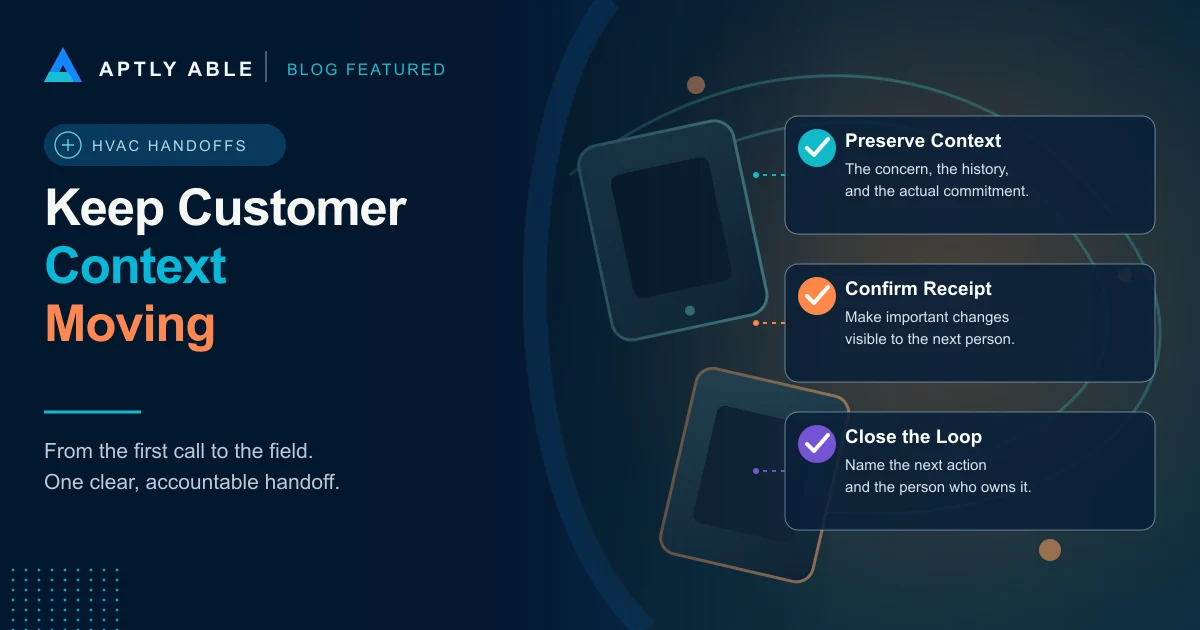
The Appointment Is Booked. Did the Context Make It?
Picture an ordinary busy morning. A CSR listens carefully while a homeowner explains an intermittent heating problem. The appointment gets booked. Dispatch finds an opening. A technician arrives on time, looks at the job notes, and asks the customer to explain everything again. This is an illustrative situation, not a customer case study.
Nobody in that sequence had to be careless for the handoff to fail. The CSR may have captured the details somewhere the technician does not normally look. Dispatch may have seen the appointment but not the promise attached to it. The technician may have received a job label instead of the conversation behind it.
That is the operational problem worth fixing: information existed, but it did not become usable context for the next person.
An HVAC dispatch handoff checklist should carry the customer's concern, relevant history, access needs, confirmed commitments, and open questions into the field. It should also make clear who receives a change and who updates the customer. The goal is not longer notes. It is a more reliable next step.
Start With the Work Your Team Already Has to Do
If the phones are stacked and the board is changing, asking everyone to write a second version of the same information is not a thoughtful process improvement. Before adding a form, trace one appointment through the tools your team actually uses. Where does the CSR enter the concern? What does dispatch see? What opens on the technician's device?
ServiceTitan recommends bringing customer information together and describes shared customer notes, job history, and equipment details as part of its dispatch workflow.[1] Smart Service describes technician assignment as the point where the work order, customer history, and prior service notes move to the technician's mobile device.[2]
Use that distinction when reviewing your own process. Information being stored is one question. Information being available at the moment of assignment is another. Ask a technician to show you the actual screen before deciding the team needs better note-taking.
Choose one shared job record as the source of truth. Use a short handoff summary there, with links to relevant history rather than copied pages of old notes. If a system limitation forces a separate message, make someone responsible for updating the job record too.
The Handoff Checklist: What the Next Person Needs
Use the following as a starting template, not a requirement to interrogate every caller. Capture what is relevant, distinguish customer reports from verified facts, and flag what still needs clarification. Do not ask a CSR to diagnose equipment over the phone.
Customer concern: What is happening, when does it happen, and what does the customer want help with? Preserve a useful phrase in the customer's own words instead of reducing everything to a broad job type.
Relevant history: Which prior visit, open estimate, or equipment record changes how this appointment should begin? Include a reference to the record. Do not treat a customer's recollection of a previous diagnosis as a newly confirmed finding.
Access and availability: Confirm the service location, arrival contact, agreed window, and relevant entry instructions. Keep sensitive access information in the approved restricted field, not in a general message thread.
Confirmed commitments: What did the office actually promise about timing, charges, the scope of the visit, or an update? Separate a request from an agreement. A customer's preferred time is not a guaranteed arrival time.
Open questions: What has not been resolved? Mark an unconfirmed detail as needing confirmation rather than filling the gap with a guess. Route safety concerns through your established escalation procedure, not an improvised checklist rule.
Owner and receipt: Who checks that the assigned technician can see the summary? Who owns a clarification? What event requires dispatch to notify the customer? A saved note is not evidence that a changed commitment was received.
Show the Difference Between a Label and a Handoff
Here is an illustrative job-note comparison. It is not an actual customer record or a recommended technical diagnosis.
Thin note: Heating issue. Customer wants someone today.
Usable handoff: Customer reports the upstairs loses heat in the early morning; downstairs feels normal. Prior visit is linked for technician review. Customer requests a same-day visit, but no same-day arrival is confirmed. Dispatch owns the availability check and has promised an update by noon. Call the listed arrival contact before entry. Technician to clarify the operating conditions before assessing the concern.
The second note does not decide what is broken. It preserves the reported symptom, separates a request from a commitment, and names the unresolved action. It gives the technician somewhere useful to begin while protecting dispatch from a promise the company never made.
Notice what is not in it: a judgment about the customer, an assumed equipment failure, or an instruction to sell a replacement. Good context should help the next employee listen, not tell them what conclusion to reach.
Make Changes Visible Without Creating Another Inbox
The first handoff is only part of the process. Decide what happens when the technician changes, the arrival window moves, or the customer calls back with new information. A complete morning note will not help with an afternoon change that never reaches the assigned person.
For a material change, update the shared record, alert the receiving employee through the agreed channel, and require acknowledgment where the change affects a customer commitment. The dispatcher should be able to tell the difference between an update that was sent and one that was accepted.
Set an escalation path for missing acknowledgment that fits your operation. If the assigned person cannot respond, the dispatcher needs an available supervisor or backup owner, not a chain of unread messages. Do not require a technician to read or respond while driving.
Close the loop in the other direction too. If the field visit leaves an unanswered question or a promised office update, send back the issue, the next action, and its owner. Do not close the administrative task while leaving the customer promise unassigned.
Review the Handoff Fairly, Not Just the Employee
When something goes wrong, look at the sequence before scoring the person. Was the detail asked for? Was it captured accurately? Was it visible in the assigned job? Was a later change communicated? Did the next employee have a reasonable opportunity to use it? Those are different failures, and they need different corrections.
Review routine appointments as well as escalations. If you only inspect complaints, you will learn about failures without seeing the conditions under which the process works. Compare similar job types and shifts before turning a few examples into a claim about one employee.
Coach the specific missed behavior when the evidence supports it. That might mean distinguishing a requested time from a confirmed window. If the CSR entered the information correctly and the field view hid it, fix the workflow instead. ServiceTitan also recommends office-and-field ride-alongs to improve understanding of each other's work.[1]
Invite employees to identify fields nobody uses and details they repeatedly have to hunt for. That feedback belongs in the process review. Accountability should make the work clearer, not make people write defensive notes.
Measure Whether Context Arrived, Then Improve One Break
Start with an operational measure you can inspect: of the appointments reviewed, how many had a usable handoff available to the assigned technician before arrival? Define usable using the relevant fields above. Record the review count and the selection method so a small or complaint-heavy sample does not pretend to represent the whole business.
Track late changes separately: was the revised commitment acknowledged, and was the customer updated? Keep process completion separate from commercial outcomes. A complete handoff is not proof of recovered revenue, and an unconverted appointment is not proof that the handoff failed.
CallSense and FieldSense can support visibility into the office and field conversations around this work. Use those insights alongside the job record and human review; do not assume a summary is complete or that a flagged phrase proves misconduct. Confirm what was actually said and which process step needed attention.
Choose one recurring break to improve first. Perhaps the team needs one visible place for arrival commitments. Perhaps technicians need a clearer route for returning open questions to the office. Make that change, review comparable appointments again, and ask the receiving team whether the information is easier to use.
A useful handoff lets a customer continue a conversation instead of starting over. It also lets the next employee do good work without reconstructing somebody else's day. That is a practical standard worth building into the process.
HVAC Dispatch Handoff FAQs
What should an HVAC dispatch handoff include?
Include the reported concern, relevant service history, access and availability details, confirmed commitments, open questions, and the owner of the next action. Keep customer reports separate from verified findings.
Who owns the handoff from the CSR to the technician?
Assign responsibility explicitly: the CSR captures intake context, dispatch checks assignment and material changes, and the technician reviews the job before arrival. Name a backup for unresolved questions rather than relying on shared ownership alone.
How much detail belongs in HVAC job notes?
Include enough context for the next person to begin informed, with links to relevant history. Avoid copying entire records, adding unsupported diagnoses, or recording irrelevant personal details.
How should dispatch handle a changed arrival commitment?
Update the shared job record, alert the assigned employee, confirm acknowledgment, and assign the customer update. Use an escalation path if the receiving employee is unavailable.
How do you measure handoff quality?
Review whether relevant context was accurate and available before arrival, and whether material changes were acknowledged. Report the review count and sampling method, and track customer and revenue outcomes separately.
Recommended next reads
Related Aptly Able resources
- CallSense Review booking conversations for customer concerns and promises that need follow-through.
- FieldSense Bring field-conversation visibility into coaching and follow-up.
- Why In-Home Appointments Don't Close Explore the wider connection between customer context and appointment outcomes.
- Revenue Recovery Audit Identify gaps between the opportunities you book and the follow-through customers receive.
Helpful external reading
- [1] ServiceTitan: HVAC Dispatching Tips Customer information, shared notes, and office-to-field understanding in HVAC dispatch.
- [2] Smart Service: Field Service Dispatch Management The dispatch workflow from intake through technician assignment and field execution.