A Callback Is a Customer Conversation Before It Is a Score
A homeowner calls and says, “The system is doing the same thing again.” The CSR sees a completed ticket. Dispatch sees a board that is already full. The service manager sees a technician name.
It is easy to jump straight to: Who messed up?
That question is fast. It is also usually too small.
The business problem is not only that a truck may need to go back. The customer is unsure whether the first visit solved anything. The office has to decide what to promise. The returning technician needs the history. And somebody has to own the next step before the customer calls another company.
Reducing callbacks starts by treating that whole sequence as one customer journey. You still hold people accountable. You just make sure the review answers the commercial question too: what does this customer need now, and what has to change so the same opportunity is not lost twice?
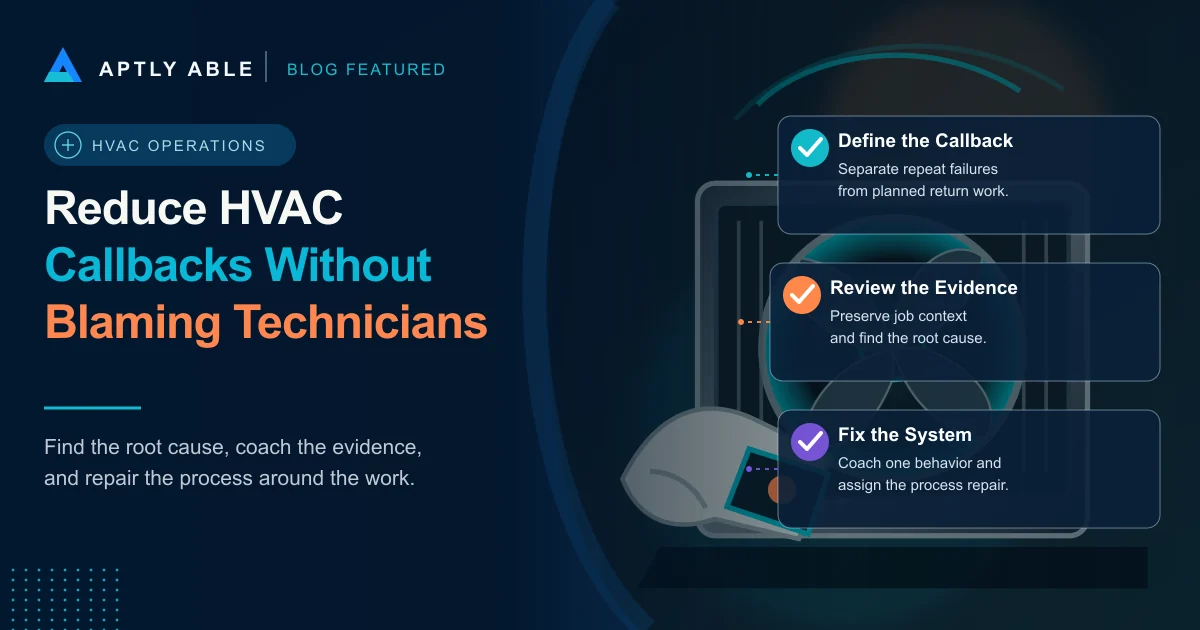
Define the Callback Before You Blame the Technician
Not every return visit is the same.
A planned return for an ordered part is not an incomplete diagnosis. A new component failure is not automatically a failed first repair. A customer-education visit is different from an installation correction. If all of those visits land in one “callback” bucket, the number will not tell an owner what to fix.
Write a practical definition. Then give the office a small set of reason codes: same symptom unresolved, different failure, planned return, parts or warranty, installation correction, customer expectation, incomplete diagnosis, and undetermined.
Keep “undetermined.” It is better than forcing a clean answer when the notes do not support one.
ACCA separates callback costs into technician labor, overhead, and the opportunity cost of work the company could have completed instead.[1] Use your own records to calculate those costs. Count the actual travel, labor, office time, parts, credits, and displaced work you can defend. Do not turn every callback into an imaginary lost sale.
The number should help you make a decision, not win an argument.
Preserve the Customer’s Words and the Promised Next Step
A callback review often starts with the second ticket. That is too late.
Start with what the customer originally said. Then look at what the CSR entered, what dispatch passed to the technician, what the technician found, what was tested, what the customer was told, and what the company promised next.
Here is an illustrative example, not a real customer quote:
Illustrative customer: “It cools during the day, but the upstairs gets hot again every evening.”
Illustrative CSR response: “I’m sorry you’re dealing with that again. I can see the prior visit. I’m going to keep your original evening-temperature concern attached to this return, and our service manager will review the measurements before the technician arrives. I will update you by 2 p.m. with the appointment window.”
That answer does three useful things. It shows the customer they do not have to start over. It preserves the condition that matters—what happens in the evening. And it creates a named next action with a deadline.
Now compare it with: “I’ll put you back on the schedule.”
Both responses create activity. Only one creates confidence and ownership.
ENERGY STAR identifies equipment sizing, airflow, refrigerant charge, and duct evaluation as separate factors in HVAC performance.[3] That matters because “still not cooling” is a symptom, not a root cause. The returning technician needs the original condition and the prior evidence, not just a label that says callback.
Use a Closeout That Answers the Buying Questions
Before the truck leaves, the technician should be able to answer the questions the customer is already asking:
- What did you find?
- What did you change?
- Did you test the original problem?
- Is the system fully resolved, temporarily operating, or waiting on something?
- What happens next?
- Who owns it?
The exact proof depends on the job. ACCA recommends reviewing service records for common callback reasons and using different checklists for maintenance, installation, and repair because the work is different.[2]
That is the point. A generic checked box does not prove that the customer’s concern was re-tested.
For a demand-service call, closeout might require the reported symptom, diagnostic path, relevant measurements, repair decision, and a test of the original condition. For an installation, it may require startup data, airflow, refrigerant verification, customer orientation, and a clear list of any open items.
If a part is on order, say so. If an intermittent issue is not reproduced, say so. If the system passed today’s test but the team needs evening operating data, assign that follow-up before the ticket is closed.
Clarity protects the customer relationship and gives the next employee a useful starting point.
Coach the Moment That Can Change
“Be more careful” is not coaching.
A service manager needs to show the exact moment that created risk. Maybe the technician never restated the original concern. Maybe the required measurement is missing. Maybe the system was tested, but not under the condition the customer described. Maybe the technician said “you should be good” when the honest answer was “the repair is complete, but we still need to confirm performance during the evening load.”
Practice the replacement behavior. That could be one better diagnostic question, one measurement, one closeout explanation, or one request for technical help.
Then check the system around the technician. Did dispatch include the customer’s original words? Was there enough time on the schedule? Could the technician see the prior history? Did the office promise a result before the field team reviewed the job?
One person may own the behavior. Management still owns the conditions around the work.
Turn Every Callback Into a Clear Recovery Plan
When the return visit is created, assign the work in plain language:
- The CSR owns the customer update and confirms the appointment window.
- Dispatch owns the complete job context and the right skill match.
- The returning technician owns the technical findings and customer closeout.
- The service manager owns the root-cause decision and any coaching.
- The operations owner owns a checklist, scheduling, inventory, or handoff fix when the pattern points beyond one person.
Close the callback only when the customer outcome and the next step are clear. A technical repair without a customer update is not a complete recovery. A customer apology without a technical resolution is not complete either.
FieldSense can help preserve what happened in the field conversation, what was promised, and what still needs action. It does not replace technical standards or a service manager’s judgment. It gives the team better context for the next conversation and better evidence for coaching.
Review Patterns, Then Pick One Change
One callback can be unusual. Five callbacks with the same missing closeout step deserve attention. Five technicians struggling with the same job type may point to training, tooling, scheduling, documentation, or inventory—not five separate attitude problems.
Review callbacks weekly by job type, symptom, root-cause code, equipment, technician, dispatcher, time of day, and completion evidence. Look for enough examples to see a pattern before changing a scorecard or labeling a person.
Do not let the meeting end with “we need to watch this.” Choose the next action.
If evening no-cool complaints keep returning, the service manager owns a revised diagnostic standard and a date to review it. If original customer concerns disappear between booking and dispatch, the CSR manager owns the intake prompt. If promised customer updates are not happening, one office leader owns the open-callback queue every day.
Activity is not the goal. A resolved customer, a completed promise, and fewer preventable returns are the goal.
Start With the Next Ten Callbacks
You do not need a 90-day transformation plan to begin.
Take the next ten callbacks. Apply the written definition. Preserve the customer’s original words. Assign the customer update. Record the technical finding. Name the root cause only when the evidence supports it. Give every remaining action an owner and due date.
At the end of ten, ask three questions:
- Which problems were truly technical?
- Where did context or follow-through break?
- What one process change would prevent the most repeat work?
Then make that change and keep measuring.
That is a fair standard for the technician and a useful standard for the business. The customer gets a clear recovery instead of another vague promise. The manager gets a coachable moment instead of a general warning. And the owner gets a process that turns callback data into the next right action.
HVAC Callback FAQs
What is an HVAC callback?
An HVAC callback is a return visit related to a recently serviced or installed system. Use a written definition and separate preventable repeat failures from planned returns, new failures, warranty work, parts delays, and customer-education visits.
How do you calculate HVAC callback rate?
Divide callbacks that meet the company’s written definition by comparable completed service or installation jobs, then multiply by 100. Keep the time window, job types, exclusions, and reason codes consistent.
What causes HVAC callbacks?
Common causes include incomplete diagnosis, missing customer context, rushed scheduling, unclear expectations, weak closeout verification, installation or airflow problems, parts issues, poor handoffs, and next steps with no owner.
How can an HVAC company reduce callbacks?
Define and categorize callbacks, preserve the customer’s original concern, use job-specific closeouts, verify the reported issue, coach one observable moment, and assign every customer, technical, and process action to an owner.
Should technicians be penalized for every callback?
No. A return visit does not automatically prove technician error. Review the customer conversation, job context, technical evidence, parts, workload, prior promises, and whether the return was planned before deciding the cause.
Who should own an HVAC callback?
Ownership is shared but explicit: the CSR owns the customer update, dispatch owns complete context and skill matching, the technician owns technical findings and closeout, and the service manager owns root-cause review, coaching, and process repair.
Recommended next reads
Related Aptly Able resources
- FieldSense Preserve field-conversation context, promises, and next actions for stronger follow-through and coaching.
- HVAC Revenue Recovery See how Aptly Able helps HVAC companies recover opportunities across calls, customer lists, estimates, and field execution.
- Why In-Home Appointments Don't Close Learn how customer context, buying questions, and follow-up affect appointment outcomes.
- What Is Call Scoring? Build observable scorecards that connect customer conversations to useful coaching.
- Revenue Recovery Audit Identify where field execution, calls, estimates, or customer follow-up are leaving recoverable revenue behind.
Helpful external reading
- [1] ACCA: The True Cost of Callbacks ACCA separates callback costs into technician labor, overhead, and lost opportunity.
- [2] ACCA: Using Checklists to Reduce Callbacks ACCA recommends reviewing callback records and using different checklists for maintenance, installation, and repair work.
- [3] ENERGY STAR: HVAC Quality Installation ENERGY STAR identifies equipment sizing, airflow, refrigerant charge, and duct evaluation as quality-installation factors.