
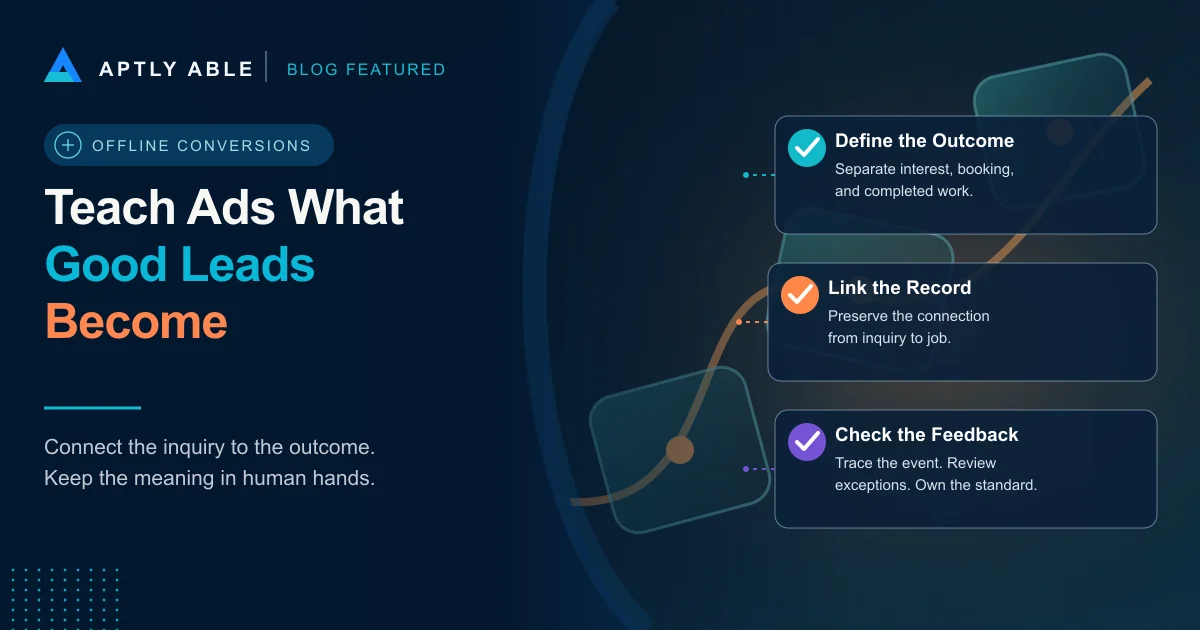
Do Not Ask Automation to Guess What Success Means
A form submission is not a finished HVAC job. It is not even proof that the company can help the person who submitted it.
That distinction should shape the way leaders evaluate advertising. If the report stops at inquiries, the business still needs a way to tell the difference between attention and useful opportunity. More activity is not the same as better work.
HVAC offline conversion tracking connects a later business outcome with an earlier advertising interaction. Google describes offline conversion imports as a way to measure what happens after an ad produces a click or call, including sales that happen away from the website.[1] The leadership decision comes first: which outcome deserves to be sent back?
Do not begin with the integration. Begin with the meaning.
Choose the Outcome Before You Connect the Systems
Google distinguishes a qualified lead, further qualified in a CRM or internal system, from a converted lead that has completed a business-defined step, such as a closed sale.[2] The label does not decide whether your company means booked, sold, completed, or paid. You have to make that decision.
For an HVAC service campaign, a proposed qualified-lead definition might require a genuine request for a service the company offers, inside its service area, with enough information for the team to act. A replacement campaign may need a separate definition that reflects a real estimate opportunity. These are suggested operating rules, not Google requirements or industry benchmarks.
A scheduled appointment can be a useful intermediate signal. An accepted proposal can be another. Neither should be labeled completed revenue. Name each event so that an owner, marketer, and dispatcher would describe the same thing after reading it.
Write down the evidence required to advance the record. If booked means a confirmed appointment in the scheduling system, a note saying the customer seemed interested does not qualify. A human still owns the standard, even when software moves the data.
Preserve the Connection From Inquiry to Job
For GCLID-based imports, Google documents saving the click identifier with the lead information and later returning it with details of the conversion and when it happened.[1] Enhanced conversions for leads supplements offline data with user-provided data, such as hashed customer information, to support matching back to advertising interactions.[1] These are matching mechanisms, not a substitute for accurate job records.
Ask the implementation owner to show the path in your actual systems: initial inquiry, customer or opportunity record, qualifying decision, appointment or job, and the event sent back. Preserve identifiers and timestamps instead of relying on a person's name to join records after the fact.
Keep event time separate from upload time. Preserve the original inquiry when the customer calls again. A repeat contact should not automatically create another qualified opportunity, and a rescheduled appointment should not become a second sale.
If the relationship between records is uncertain, hold it for review. A missing match is a problem to investigate. An invented match is a problem the report hides.
Do Not Rebuild an Outdated Upload Recipe
Implementation advice has a shelf life. Google's current offline-import documentation includes a June 2026 migration notice directing offline conversion and enhanced-conversion lead uploads toward the Data Manager API, with legacy Google Ads API access subject to restrictions.[1] Do not approve a new connector simply because an old tutorial still runs through a familiar sequence of screens.
Google recommends enhanced conversions for leads for advertisers starting offline conversion measurement, and its documentation describes Data Manager as a setup or upgrade route.[1] Have the person responsible for your account confirm the supported method, the connector's current compatibility, and how failures will be reported before enabling an unattended upload.
This is an operating guide, not a universal configuration recipe. Website forms, phone-originated opportunities, CRM integrations, and existing account settings can require different implementation decisions. Require the implementer to document which path was selected and why it fits the actual lead journey.
Review what customer information will leave your systems before connecting it. Google's documentation calls for clear information about data collection and consent where required by law or applicable policies.[1] Treat that review as part of implementation, not as something a successful test upload settles.
Audit a Real Journey Before Trusting the Dashboard
Consider an illustrative scenario, not an Aptly Able customer result. A homeowner submits a replacement inquiry after clicking an ad. The office confirms service fit, an estimate visit is booked, and the homeowner later accepts a proposal. Installation has not happened yet.
The record can support separate qualifying, booking, and sale-stage events if those are the company's defined milestones. It cannot support completed-installation revenue. If the appointment is moved, preserve the relationship to the original opportunity rather than presenting the change as another new customer.
For a controlled implementation test, trace the source record through the connector to the destination account. Confirm the event name, timestamp, value basis when used, and whether the record was accepted. Then test how the integration handles a repeated upload, a missing identifier, and a changed or canceled outcome. Use the connector's supported test and correction procedures; do not inject fake customer wins into production reporting.
Google provides an enhanced-conversions diagnostics report to help identify implementation issues such as missing or incorrectly formatted user-provided data.[1] Use diagnostics alongside record-level reconciliation. A successful transfer shows that data moved. It does not prove the underlying decision was correct.
Keep the Feedback Useful When People Disagree
A marketer may see a conversion. A CSR may see an incomplete request. A sales manager may see an estimate that never reached a decision. Bring those views together before assigning blame or changing a budget.
Review a small, varied set of records with the team: a clear fit, a non-serviceable inquiry, a duplicate, a booking that canceled, and a completed job. Ask whether each person would apply the same stage definition. Correct the definition or the workflow where they would not.
CallSense is relevant to the conversation-review side of that work. Use available call evidence to understand what the customer wanted and what the team agreed to do. Do not assume a conversation-analysis tool automatically uploads Google Ads outcomes, or let an AI summary certify a sale that the operating record does not show.
The purpose of automation is to remove repeated data handling and expose exceptions. It should not remove the responsibility to decide what the evidence means.
Change the Signal Deliberately, Not All at Once
Treat the first connected period as a verification period. Compare source records, eligible events, accepted uploads, and visible results. Keep excluded and unmatched records visible. Assign one person to investigate gaps and another appropriate business owner to approve changes to the definitions.
Before changing campaign goals or bidding, have the account manager review which actions are used for optimization and which are retained for observation. Do not let several milestones from the same customer quietly stand in for several independent business wins. Assess the volume and delay of the chosen outcome before expecting it to support a useful feedback cycle.
Keep the broader recovery scorecard separate. Offline conversion feedback tells an advertising platform about a defined outcome; it does not by itself prove that a follow-up campaign caused additional revenue or that a job was profitable. Those questions belong in the linked operational and financial review.
The leadership standard is straightforward: the team should be able to trace the event, explain its meaning, and correct it when reality changes.
Teach the system what good work becomes. Keep people responsible for what good means.
HVAC Offline Conversion Tracking FAQs
What is HVAC offline conversion tracking?
It links a later HVAC business outcome, such as qualification or a closed sale, to an earlier advertising interaction. Define the outcome and preserve the supporting CRM or job record before sending the event back to the ad platform.
Should an HVAC company send bookings or completed jobs back?
Choose a clearly defined outcome that fits the campaign and can be recorded reliably. Bookings and completed jobs are different milestones; use distinct names and review how each is used before changing optimization settings.
Does a qualified lead mean a sold HVAC job?
No. Use qualified lead for an inquiry that meets documented fit criteria. Keep sale, completion, and payment milestones separate so a useful inquiry is not mistaken for earned revenue.
What should be checked before enabling an offline conversion connector?
Check the current supported upload method, record matching, event definitions, timestamps, duplicate handling, error reporting, and privacy requirements. Verify a controlled end-to-end journey rather than relying on a connected status alone.
Can call analysis replace the job record for conversion reporting?
No. Conversation evidence can help explain intent and the agreed next step. Confirm bookings, sales, and completed work in the appropriate operating records before reporting those outcomes.
Recommended next reads
Related Aptly Able resources
- CallSense Review conversations to understand the quality and next step behind a lead.
- HVAC Call Booking Rate Define the separate operating measure of qualified calls becoming appointments.
- Measure HVAC Revenue Recovery Use the broader framework for unique-job attribution, financial outcomes, and incremental recovery.
- Revenue Recovery Audit Find gaps between customer interest, follow-through, and recorded outcomes.
Helpful external reading
- [1] Google Ads: About Offline Conversion Imports Google's current documentation on offline outcomes, enhanced conversions for leads, matching, and upload methods.
- [2] Google Ads: Qualified Leads and Converted Leads Google's definitions for deeper lead stages and the business's responsibility to choose the conversion step.